A World on the Move: How Migration Is Reshaping Global Society
Human migration is often discussed through numbers: how many people cross borders, how many apply for asylum, how many workers move abroad. But behind those statistics is a much larger transformation. People are changing where they live, where they work, where their children grow up and how communities maintain connections across borders.
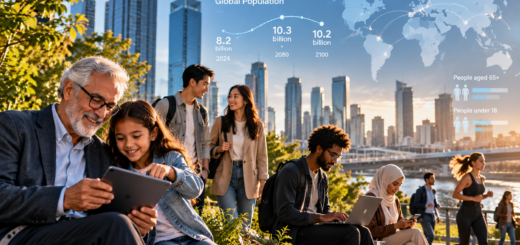
In 2024, an estimated 304 million people worldwide were international migrants, almost twice the number recorded in 1990. Yet international migrants still represented only about 3.7 percent of the global population, meaning that the vast majority of people continue to live in the country where they were born.
The important story, then, is not that everyone is suddenly moving. It is that migration has become an increasingly important part of how the global economy and societies function.
Migration Has Many Different Faces
There is no single migration experience.
Some people move because they have found a job or want access to better professional opportunities. Others relocate for education, family reasons or long-term lifestyle changes. Still others are forced to leave because of war, persecution, economic collapse, environmental disruption or natural disasters.
The International Organization for Migration’s World Migration Report 2026 describes contemporary mobility as the result of several forces operating simultaneously, including demographic change, environmental disruption, technological transformation and geopolitical tensions.
That complexity makes simple explanations increasingly inadequate. Migration is not solely an economic phenomenon, nor is it exclusively a humanitarian issue. It can involve both at the same time.
A person may cross a border because of employment while also sending money to relatives, acquiring new skills, supporting a family business and maintaining strong connections with the community they left behind.
Work Remains One of the Biggest Drivers
Employment continues to play a central role in international migration. Workers move toward economies where their skills are in demand, while employers increasingly depend on people who have crossed borders to fill gaps in labour markets.
This creates a relationship of mutual dependence. Migrants need access to employment and legal status, while economies need workers across a wide range of sectors and skill levels.
IOM reports that migrant workers make up the majority of international migrants, while the global number of migrant workers increased by more than 30 million between 2013 and 2022, according to the latest available estimates.
The effect goes beyond individual workplaces. Migration can influence population structures, consumer demand, housing markets, education systems and the supply of specialised skills.
For countries experiencing population ageing or labour shortages, attracting workers from abroad can become an important part of maintaining economic activity.
Migration Also Connects Economies From a Distance
Moving to another country does not necessarily mean cutting ties with the place a person left.
Millions of migrants send part of their earnings to family members and communities in their countries of origin. These transfers can pay for housing, education, healthcare and everyday expenses, while also supporting small businesses and local investment.
According to IOM, remittances were expected to reach around $905 billion globally in 2024, including approximately $685 billion flowing to low- and middle-income countries.
That makes migration an economic connection extending far beyond the destination country.
A worker may therefore participate simultaneously in two economies: earning income in one country while supporting consumption, education or investment in another. Over time, these financial relationships can become an important part of development and family security.
The Geography of Migration Is More Complicated Than It Looks
Popular discussions sometimes imagine migration as a simple movement from poorer countries toward richer ones. Reality is considerably more complicated.
People migrate between neighbouring countries, within regions and between economies at very different levels of development. Some countries are simultaneously places of origin, transit and destination.
IOM’s 2026 regional analysis emphasises substantial differences between migration patterns in Africa, Asia, Europe, Latin America and the Caribbean, Northern America and Oceania. There is no single global migration route or universal migration profile.
This matters because migration policy cannot be designed around one global model. The pressures facing a rapidly growing labour market can be very different from those facing an ageing economy, a major transit hub or a country experiencing large-scale displacement.
Cities Are Changing With Their Populations
Migration is also reshaping urban life.
New arrivals contribute to the workforce, create businesses, introduce languages and cultural practices, and change demand for housing, transportation, education and public services. In large metropolitan areas, international migration can become one of the forces behind cultural and economic diversification.
The effects are not always straightforward. Rapid population growth can put pressure on housing and infrastructure if cities cannot expand services quickly enough. Successful integration can strengthen local economies, while weak access to employment, education or social services can deepen inequality.
This makes migration increasingly a question of urban planning as well as immigration policy.
The cities that adapt successfully are likely to be those that treat newcomers not simply as temporary arrivals, but as participants in the long-term life of the community.
Technology Is Changing How People Move
Technology has also transformed migration.
People can now research employment opportunities, compare destinations, communicate with employers, maintain relationships with family members and transfer money across borders using digital tools that barely existed a generation ago.
Social networks have made it easier for potential migrants to obtain information from people who have already made similar journeys. Digital communication also allows families to maintain much stronger connections despite physical distance.
At the same time, technology introduces new risks. Online misinformation can influence migration decisions, while digital systems used for border management, recruitment and identity verification raise questions about privacy, surveillance and access.
The result is a migration environment in which physical movement and digital connectivity increasingly operate together.
Climate Change Is Adding Another Layer
Environmental change is becoming an increasingly important part of the migration discussion.
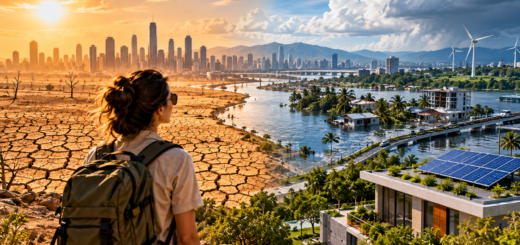
Climate-related pressures can affect livelihoods, housing, food security and access to water. In some cases, people move temporarily after disasters. In others, repeated environmental stress can contribute to longer-term relocation.
IOM’s World Migration Report 2026 identifies environmental disruption as a central feature of contemporary mobility and examines the growing importance of community-level responses to climate-related movement.
It is important not to treat climate change as a simple explanation for every movement of people. Migration decisions usually involve several factors at once. Economic conditions, family circumstances, conflict, public services and environmental pressures can interact in complicated ways.
That makes future migration patterns difficult to predict precisely.
The Question of Regular Migration
One of the most important debates concerns how countries create legal and predictable ways for people to move.
IOM’s 2026 research argues that regular migration pathways can provide benefits for migrants, origin communities and destination economies, while restrictive approaches can push some movement toward more dangerous or irregular routes rather than eliminating the underlying demand to migrate.
This does not mean that borders or immigration rules are becoming irrelevant. Governments will continue to decide who can enter, work and remain in their territories.
The larger challenge is designing systems that recognise economic needs and humanitarian responsibilities while maintaining effective governance.
Migration Is Becoming Part of the Global Economic Structure
The deeper significance of migration is that it connects demographic change, employment, development and culture.
An ageing society may need workers. A younger society may have a growing labour force but limited opportunities. A family may depend on income earned abroad. A company may need skills that are difficult to find locally. A city may gain new businesses and cultural connections through newcomers.
These relationships create a global system in which movement of people is closely linked to movement of money, knowledge and ideas.
Yet the benefits are not automatically distributed. Access to safe and regular migration remains unequal, and IOM notes that opportunities are often more accessible to people from higher-income backgrounds and countries than to those from poorer contexts.
That inequality will remain one of the central challenges of migration policy.
A More Connected but More Complicated World
Migration is not likely to disappear as economies, populations and environmental conditions change. If anything, the forces shaping human mobility are becoming more interconnected.
The future will not necessarily be defined by dramatically larger numbers of people crossing borders. It may instead be defined by more varied forms of movement: temporary work, international study, skilled migration, family relocation, regional mobility, climate-related displacement and repeated movement between countries.
The challenge for governments and societies is to manage this complexity without reducing migration to a single political narrative.
People move because economies create opportunities, families make decisions, crises force choices and changing environments alter what is possible. Those forces will continue to shape the world in the years ahead.
Migration is therefore not simply a story about people leaving one place and arriving in another. It is part of the infrastructure of an interconnected world, influencing how economies grow, how cities evolve and how societies themselves change.